Three things to know about starting scuba diving
Scuba diving can open up a new world. Three things to know about getting your diving certification and becoming a responsible diver.


Learning to scuba dive is one of the best decisions I’ve made in life. It opened up a brand-new world that cannot be experienced through snorkelling. However, getting into scuba diving can be daunting: What does it entail? How to choose diving centres? How difficult is it? We have put together a guide if you are contemplating learning to scuba dive but don’t know where to start.
I. PADI Certification
Scuba diving certifications are normally obtained through PADI or SSI - both are recognised internationally. As I am PADI-certified, this article is based on the PADI certification process.
The entry point is the PADI Open Water Certificate, which allows you to dive up to 18 meters. Afterwards, you can work towards obtaining the Advanced Open Water Certification, which would extend the maximum dive depth to 30 meters. You can also choose speciality dive qualifications, such as Enriched Air (Nitrox) Diver, Night Diver, and Dry Suit courses. There are also regional speciality dive courses such as reef survey speciality, which is offered at some dive centres in Australia. Dry Suit speciality is recommended for people who plan to dive in colder waters.
There are three main steps to get your PADI Open Water certification:
Step 1: Theory Learning
Find a reputable PADI dive centre near you to start your journey. Many dive centres are located within city centres, so you don’t have to go somewhere coastal to start learning. With Open Water, you can start learning in the swimming pool.
After purchasing your PADI course, the dive centre will provide you with access to PADI’s online portal for theory learning. This is a really important part, as you’ll learn about the fundamental physics of diving, common issues that you may encounter underwater, hand gestures, and how to solve potential problems. At my diving centre, there was also an exam before shallow water training, which you must pass before diving into the pool.
Step 2: Shallow water or pool training
Once the theory learning is completed, the next step is shallow water training. This is usually conducted in a swimming pool or shallow sea area. A reputable diving centre will require you to pass a swimming test first. When I got certified in London, I had to swim several laps in the pool to prove my swimming ability before proceeding. Some diving centres claim you can qualify without being able to swim, and you often encounter these at popular dive resorts or destinations. A reputable diving centre would never allow non-swimmers to dive. Scuba diving is one of those activities where you don’t normally encounter problems underwater, as you would prepare your gear carefully to make sure it is ready for the dive. However, when you do encounter issues, they can be sudden and unexpected, and if you can’t swim in the open ocean without your scuba equipment, it can be the difference between life and death. For example, your diving kit may get entangled in a rock or reef wall, and you’ll need to remove it and swim to the surface; another scenario could be running out of oxygen underwater and having to surface without any assisted buoyancy. Not knowing how to swim could lead to tragic consequences in such situations.
This part of the qualification normally takes 3 days, and you’ll learn a series of skills such as getting in and out of your scuba kit in the water, mask removal underwater, getting neutral buoyancy, and breathing from a leaking regulator. You may not be able to get all of them in one go, and some dive centres would let you have extra pool sessions if you struggled with some of the tasks. I had to take an extra session for my full mask removal!
Step 3: Open water diving
After completing shallow water training, you will do two days of open water diving, which normally consists of four dives in total. This is normally done in a lake or the ocean. You will need to demonstrate the skills you’ve learned in shallow water training to pass the test. The last dive is normally a fun dive, so you get a sense of what it is like to just swim around underwater!
II. How to Choose a Diving Centre on your travels
Congratulations, you are now a certified diver, and will probably be looking forward to booking your first diving holiday! I usually choose a Five-star PADI Dive Centre, which can be found on the PADI website. This is because they tend to have better-qualified dive masters and better-maintained equipment, which are crucial for your survival underwater.
III. Extra notes
It is a privilege to share the ocean with the amazing marine animals that call it home, and many divers are ambassadors for marine conservation. There are a few things we can do to help with marine conservation:
- Do not touch marine life or block their route, especially animals that need to surface for air, such as sea turtles. In some instances, you may see people riding on sea turtles, which can lead to their drowning. Just don’t touch anything.
- Do not stand on coral reefs and control fin kicking. I’ve seen people on my diving trips who would kick up all the sand with their fins (normally due to buoyancy issues), and everywhere they’ve passed was covered with dust. As someone who was diving behind, I had close to zero visibility and was in constant fear of the diver knocking my mask off. It is stressful for humans and marine life alike, so please try to learn to get neutral buoyancy and control your fin kick. It is good for you as well, as it preserves energy and makes your air tank last longer.
- Pick up underwater garbage when you see it: My wetsuit has a side pocket, which is perfect for picking up marine trash. When diving, if I see plastic bags, foam, or any garbage within reach, I would pick it up and dispose of it ashore.
- Always bring two flashlights for night dives! The first time I did a night dive in Egypt, I only brought one flashlight (new). It malfunctioned on the return journey, flickering on and off. Luckily, it was a full moon, so the surroundings were not pitch dark. Otherwise, getting lost in the sea would have been terrifying.
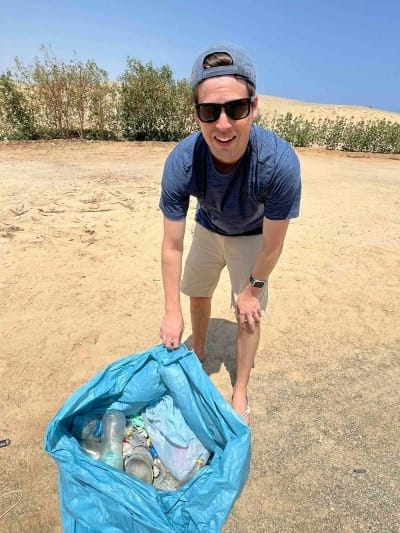
- Beach cleaning: Flying after diving can increase the risk of decompression sickness, so a rule of thumb is to wait 24 hours after your last dive before flying. If you’re on a diving holiday, this non-dive day can be perfect for beach cleaning. Unfortunately, at popular dive places, you can find all kinds of garbage on the beach. Although individual efforts may not seem like much, if every diver spends their non-dive day on beach cleaning, it could make a big difference!
Hopefully, you're excited to become PADI-qualified! We work with many dive centres, so you can check out our diving trips.
Happy diving!